
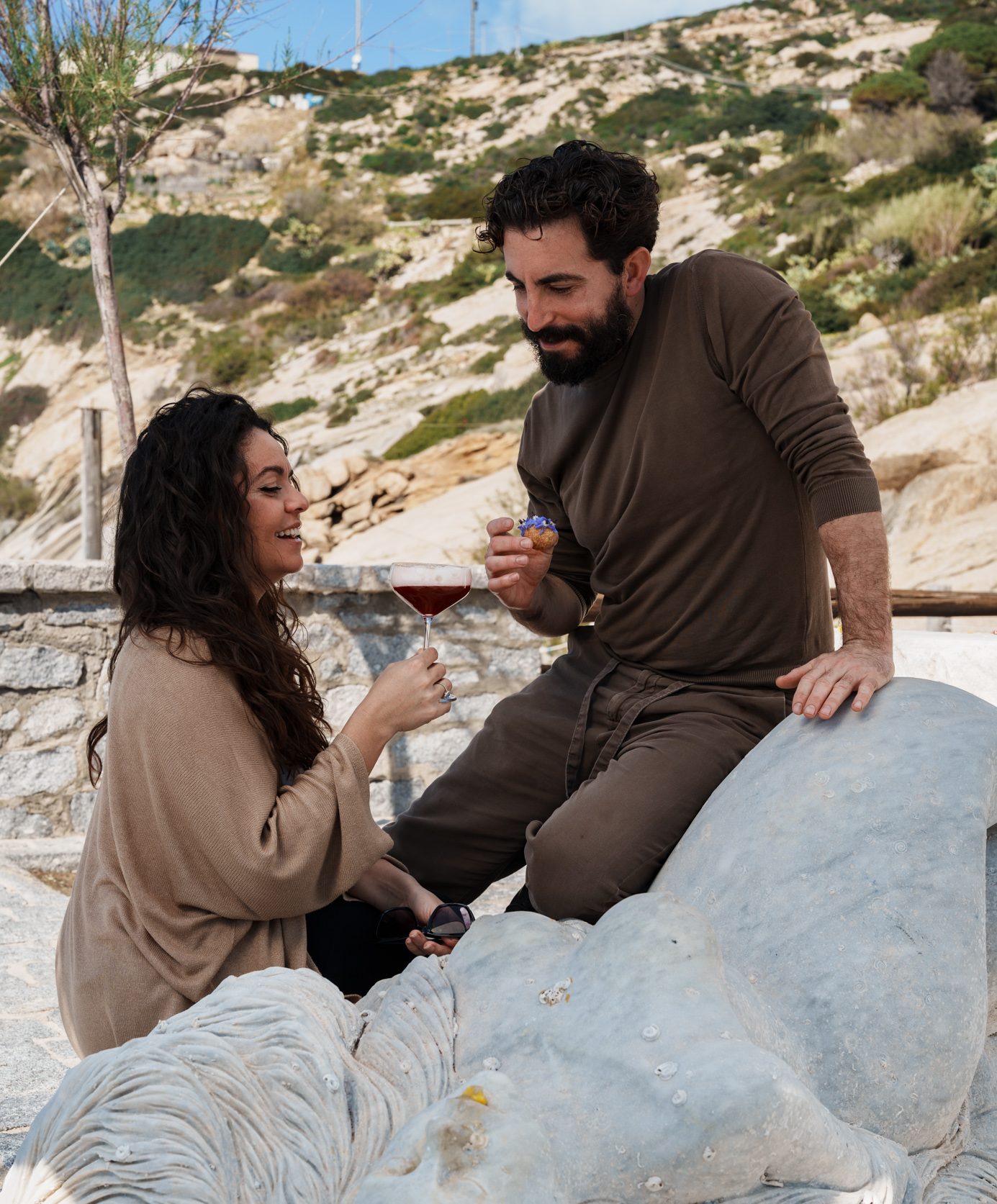
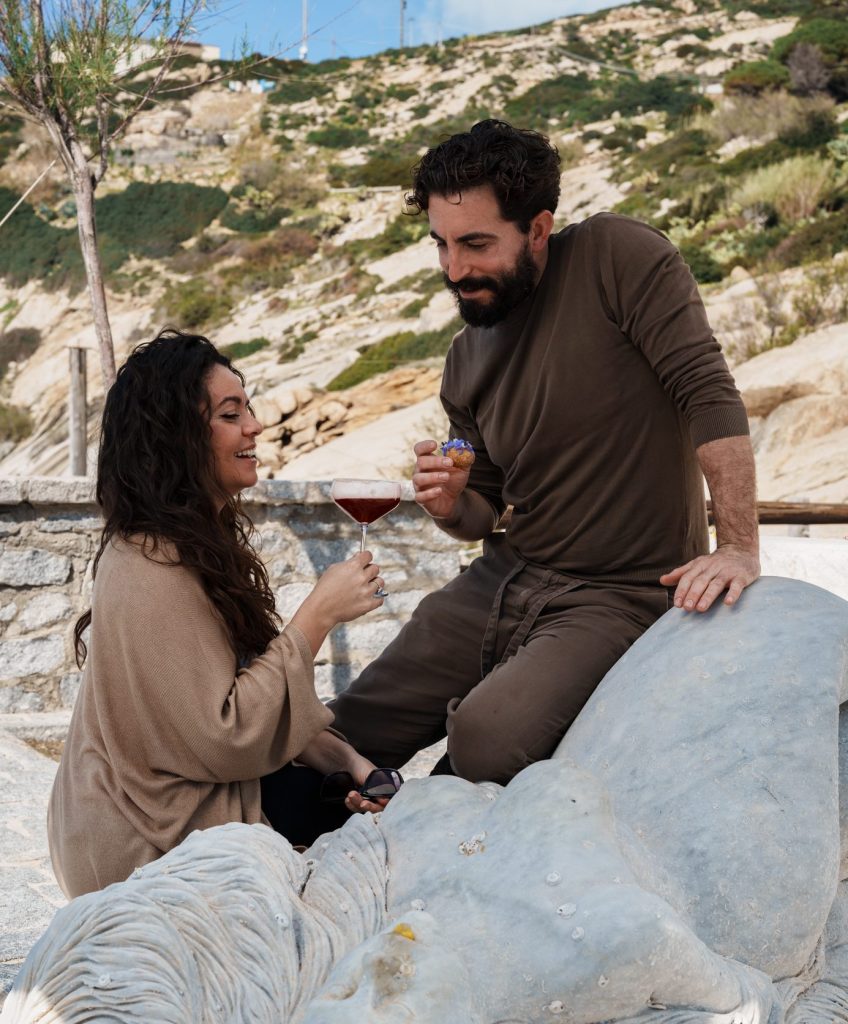
Some kitchens are born of a place and some are born of an encounter. Sentiero’s is one of the second kind: it grows from the meeting of Spanish roots and Italian roots, reinterpreted through a contemporary outlook in continuous evolution.
Ambra and Juan Carlos met in the kitchen of ABaC, in Barcelona, and what is served today in Portoferraio began there. It is worth saying from the outset, because it is not a biographical footnote: the way a restaurant cooks is usually better explained by the places the people in the kitchen have been than by the place where the restaurant stands.
Andalusia, in the south
Juan Carlos was born in Andalusia, where Africa and Europe brush against each other across the Mediterranean. His childhood passed among the stoves of his grandparents’ restaurant, among the aromas of Andalusian cooking and the murmur of guests, and there, before any technique, he learned the idea that still holds up his work: the meaning of cooking lies in serving others.
He was studying at the University of Málaga when he understood that his language was another. He left his studies and gave himself entirely to gastronomy.
Elba, in the middle of the Tyrrhenian
Ambra grew up on the island, among the scent of her grandfather’s citrus trees and her hands sunk into dough, with the childhood conviction that turning a few ingredients into something new was a form of magic. Over the years a deeper connection with the land appeared: walking among the rows of her grandfather’s vineyard, she understood how much the world of wine fascinated her, and she enrolled at the Faculty of Viticulture and Oenology in Florence, where she graduated with a thesis on Aleatico, the wine that symbolises her land. But whenever she needed to find her balance again, she went back to kneading.
Two schools, one table
Juan Carlos’s path took him through El Celler de Can Roca and then ABaC in Barcelona, where he spent more than seven years and where, as second chef, he contributed to the winning of the third star; on his days off he travelled to learn in kitchens such as Noma and Mugaritz. Ambra trained at the CAST Alimenti pastry school, joined the team of Luca Mannori, passed through Bo.TiC, Atempo and Relais Blu, and arrived at ABaC as pastry chef and head of research and development.
They met there, in the same kitchen, and from the first moment they understood that their future lay in a project of their own rather than in the great restaurants.
Serving, as well as cooking
From that childhood among the family stoves Juan Carlos keeps one concrete idea: the trade is not exhausted by technique, it is completed when the dish reaches someone. It is an uncommon conviction in kitchens of that level, where the pass and the dining room tend to be two worlds separated by a door.
At Sentiero that door never quite closes. Both cook and both come out to serve and explain, so that each course is described by the person who made the decision. It is also the reason the dining room cannot grow: twenty guests per service is the figure that keeps that way of working possible.
Returning to the island
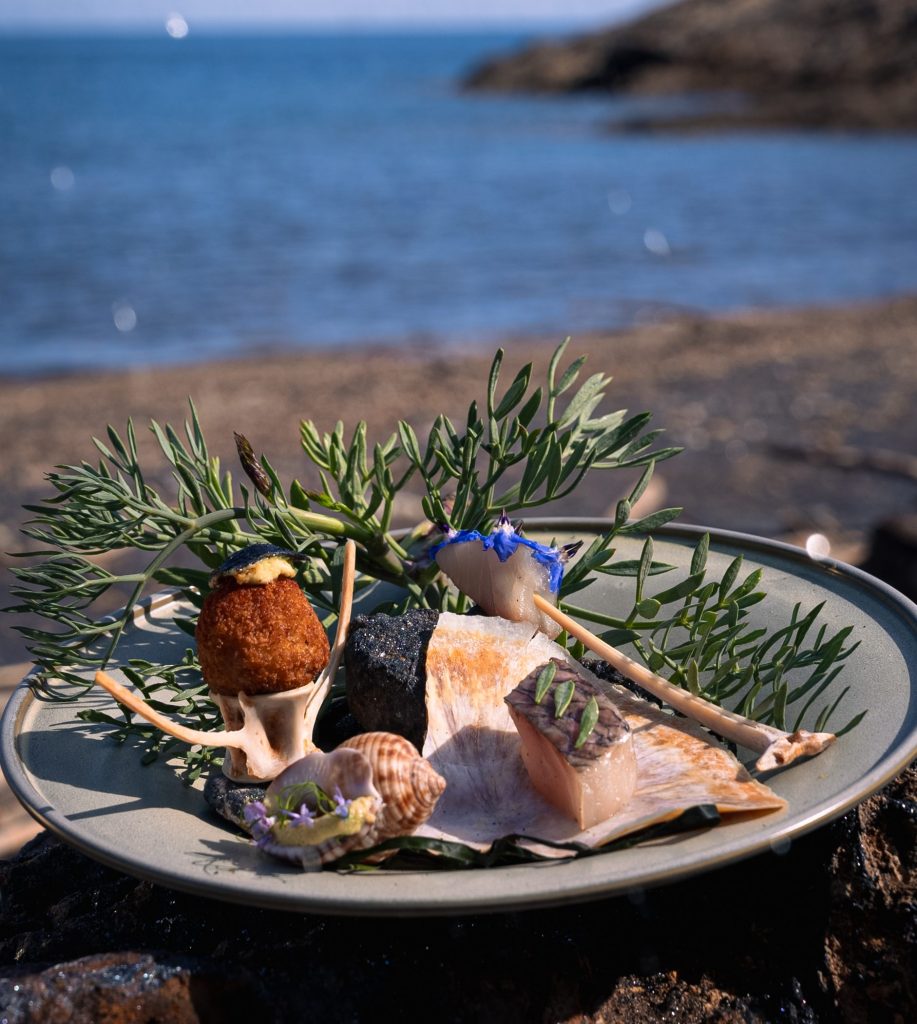
They tried first in Málaga, but the project never quite took off and time kept passing, until they decided to return to her roots: Elba. Sentiero is the result of that decision, a kitchen free of fixed schemes, guided by creativity and by respect for the raw ingredients, drawing on what the season and the territory offer each day. That is why there is no fixed menu card: the ingredients are chosen daily and dinner is composed from them.
What an accent brings
A dish made by four hands and two different memories is not a fusion dish, it is a dish that can be read two ways at once. Spanish haute cuisine technique and the Italian relationship with produce and season do not simply add up: they correct one another, and each keeps the other from becoming predictable.
Ambra and Juan Carlos serve and explain in the dining room, before twenty guests per service. In a project like this, saying where each course comes from means saying where they come from. Because some kitchens are inherited and some are built between two people.


